
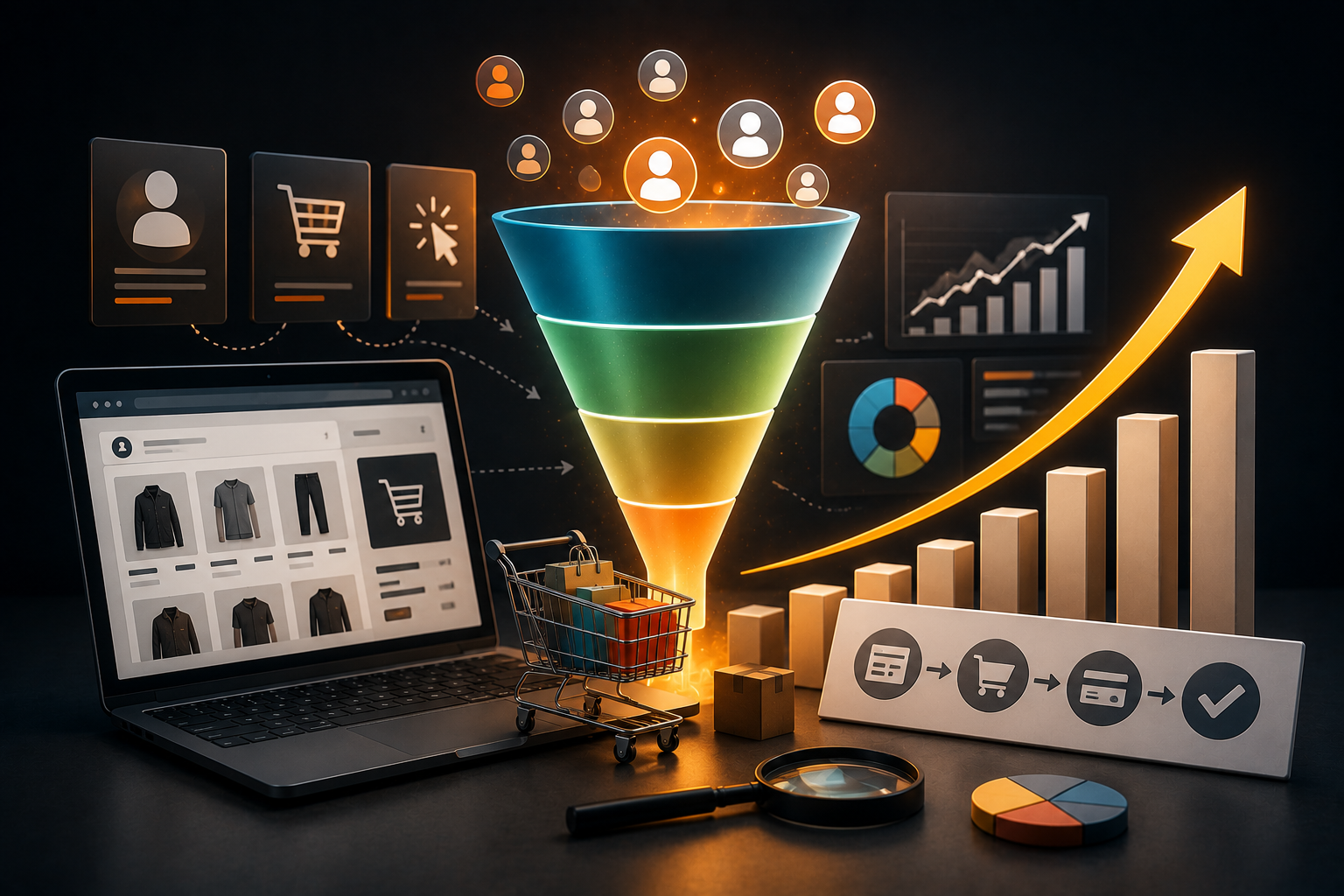
What is Conversion Rate Optimization and Why is it Important?
Conversion Rate Optimization (CRO) is a systematic approach focused on increasing the rate at which visitors to a website perform a desired action. This process is supported by data analytics, user psychology, and continuous testing. When implemented correctly, it can significantly increase revenues without increasing the traffic budget.
Modern digital marketing strategies not only bring traffic but also evaluate the quality of that traffic and its conversion potential. At this point, CRO serves as a bridge between traffic and revenue.
Data Collection to Understand User Behaviors
Heatmaps and Session Recordings
Heatmaps show where users click on a page, how far they scroll, and which areas they ignore. Session recordings allow you to watch individual visitor journeys like a video. These tools provide concrete insights into page layout and call-to-action (CTA) placement.
Form Analytics and Drop-off Points
Identifying at which step users abandon form fields helps you remove unnecessary fields or improve explanations. For example, making the "district" field mandatory in an address form may increase the abandonment rate by 12%.
Hypothesis Validation with A/B Tests
A/B tests measure performance differences by presenting two different page versions to the same traffic segment. Test duration, statistical significance, and sample size must be carefully planned. A misinterpreted test leads to wrong decisions and wasted resources.
Testable Elements
- Headline text and subheadings
- CTA button color, size, and text
- Product images and video content
- Price display format (e.g., discounted price emphasis)
- Trust badges and customer review placement
Changing only one variable per test ensures clarity of results. Multivariate tests require more complex analysis.
Strategies to Minimize Cart Abandonment
Cart abandonment is one of the biggest sources of revenue loss for e-commerce businesses. According to average industry data, the cart abandonment rate is around 70%. The following approaches can be effective in reducing this rate.
Transparent Cost and Delivery Information
Shipping fees, taxes, and additional costs should not be a surprise on the checkout page. If the estimated delivery date and free shipping threshold are displayed on the product page, uncertainty decreases when the user makes a decision.
Guest Checkout Option
Mandatory login can drive away users who want to shop quickly. Guest checkout flow increases conversion by keeping form fields to a minimum. Membership can be encouraged post-purchase and integrated into a loyalty program.
Trust Signals and Social Proof
Secure payment badges, return policy summaries, and real customer reviews reduce anxiety at the moment of payment. These signals are especially critical for new brands.
Increasing Average Order Value with Upsell and Cross-sell
Upsell means suggesting a higher-end model or a comprehensive package of the product the customer selected. Cross-sell means offering complementary products (e.g., phone case, screen protector). Both methods are effective when timed correctly and personalized.
Smart Recommendations on Product Page
"Customers who bought this also bought" blocks can be powered by collaborative filtering algorithms. Real-time stock and price data keep recommendations up to date.
Dynamic Bundles on Cart Page
A "Buy Together" button offering a discounted bundle price based on the main product added to the cart encourages additional sales. For example, a user buying a laptop could be offered a carrying case with a 10% discount.
Campaign Management and Seasonality
Special days (New Year's, Black Friday, 11.11) and seasonality cause traffic fluctuations. The campaign calendar should be planned in advance and synchronized with inventory and logistics capacity.
Personalized Discount Codes
Sending segment-specific codes (new, loyal, dormant) yields higher ROI than general discounts. Impact increases when delivered on time via email and push notifications.
Scarcity and Urgency
Messages like "Only 2 hours left" or "Last 5 items" accelerate the decision-making process. These techniques do not erode credibility when used without exaggeration and backed by real data.
Customer Loyalty and Lifetime Value (CLV)
Acquiring a new customer can cost 5-7 times more than retaining an existing one. Loyalty programs increase CLV by encouraging repeat purchases.
Points System and Rewards Center
Earning points on every purchase and creating a store where points can be redeemed for products or discounts. Gamification elements (levels, badges) increase engagement.
Exclusive Access and Early Sales
Offering loyal customers early access to new collections or VIP discount days strengthens brand attachment. These perks make the customer feel "special."
Sales Psychology and Decision-Making Process
Users act on emotional triggers, not logical ones. Anxiety, confidence, sense of belonging, and fear of missing out (FOMO) are core motivations for purchasing.
Social Proof and Authority
Celebrity endorsements, expert reviews, and "Best Seller" tags reduce uncertainty. Real customer photos and videos increase perceived credibility.
Preventing Choice Paralysis
Too many options lead to decision paralysis. Category narrowing filters, "Top 3 recommendations" lists, and comparison tables simplify the selection process.
Performance Measurement and Continuous Improvement Cycle
CRO is not a one-time project but a continuous cycle. Core metrics (conversion rate, average order value, cart abandonment rate, revenue per page) should be tracked weekly, and root cause analysis should be performed when anomalies occur.
Dashboards and Automated Alerts
Critical KPIs can be viewed on a single screen via Google Data Studio, Power BI, or custom dashboard solutions. Automated email/Slack alerts when thresholds are breached enable rapid intervention.
Customer Feedback Integration
Net Promoter Score (NPS) surveys, post-purchase pop-ups, and live chat logs add qualitative depth to quantitative data. This feedback becomes the source for future test hypotheses.
Performance-Focused Approach in E-Commerce Infrastructure Selection
Your platform's speed, scalability, and integration capabilities directly affect the outcome of CRO efforts. Slow page loads can lead to a 7% conversion loss per second. Therefore, technical SEO, caching strategies, and API flexibility should be priority criteria when making infrastructure decisions. For a detailed comparison and selection guide, you can review the Critical Criteria in E-Commerce Infrastructure Selection and Performance Optimization Guide.
Elevate Your Sales Performance to the Peak with Eticary Solutions
Eticary combines automated data-driven CRO processes, A/B testing infrastructure, personalized recommendation engine, and real-time analytics dashboards in a single platform. Automated email and push sequences triggered at the moment of cart abandonment enable you to recover 15-20% of lost sales. Upsell and cross-sell rules work in sync with your product catalog to increase average order value. The loyalty module maximizes lifetime customer value through points campaigns and VIP segmentation. All these capabilities are manageable via a drag-and-drop interface without writing code, freeing marketing teams from developer dependency and enabling rapid experimentation cycles.
In conclusion, Conversion Rate Optimization is born from the convergence of data, psychology, technology, and a culture of continuous testing. When you systematically apply the strategies summarized above, you gain the chance to significantly grow your revenues without increasing your traffic budget. Each improvement lays the foundation for the next, and this accumulation becomes the lasting source of your competitive advantage.